A new starter can read a handbook and still be unprepared for a noisy service. Restaurant training works better when the team turns broad expectations into specific actions. “Understand reservations” is too vague to assess. “Find the current booking, confirm the change with the host lead and update the authorised record” gives a trainer something observable to teach and check.
Start with the task and its boundaries
Choose a task that fits the learner’s role and current experience. State the conditions under which they may perform it, the equipment or information they need and the point where they must stop and ask. Learning to clear a table does not authorise someone to use unfamiliar chemicals or handle an unresolved guest concern alone.
Identify the applicable procedure before writing the checklist. Safety-critical work must follow the restaurant’s validated processes, manufacturer instructions and local requirements. Do not reduce a complex allergen or food-safety procedure to a generic tick box that omits the decision points.
Demonstrate, explain, then let the learner try
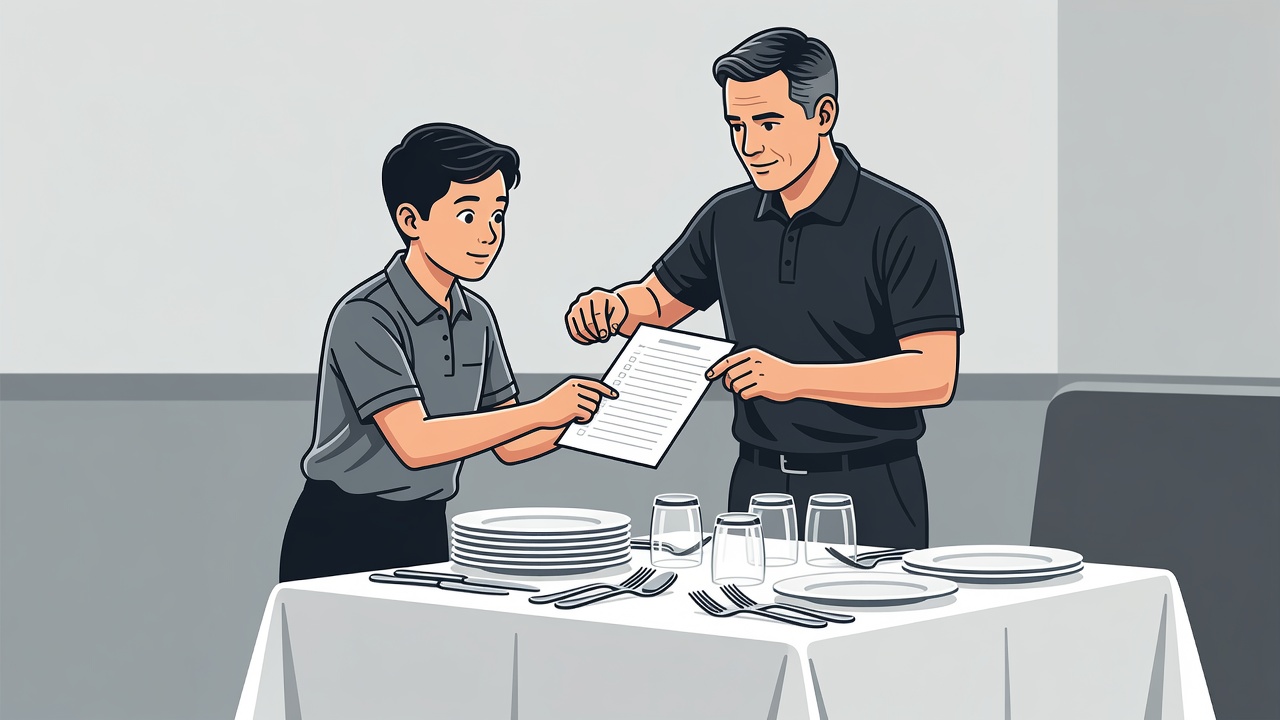
Show the task at a pace that makes the important details visible. Explain why each critical step matters, including what can go wrong and who to contact. Ask the learner to describe the sequence before practising. This is a chance to clarify the instruction, not a test of whether they can repeat the trainer’s exact words.
Allow supervised practice in realistic but controlled conditions. Avoid introducing a new skill at the busiest moment unless the task and supervision make that appropriate. The trainer needs enough capacity to observe. A person simultaneously covering several pressured stations cannot provide reliable attention merely because their name appears on a training plan.
Make the sequence and stop points visible.
Provide supervision and immediate, specific feedback.
Record what was demonstrated and any remaining limits.
Write checklists that describe evidence
Use short statements tied to observable behaviour. Replace “good customer service” with a task such as “acknowledges the guest, checks the booking in the current record and asks the lead when the table is not ready.” Include the expected source of information so staff do not learn to rely on memory for changing details.
Distinguish introduction, supervised practice and independent sign-off. Those are different states. Record the date, trainer and any restrictions, but avoid collecting unnecessary personal information. When a learner is not ready, document the next practice opportunity rather than using an unexplained failure mark.
| Task | Evidence to observe | Support boundary |
|---|---|---|
| Booking update | Uses the current record and confirms the change | Capacity decisions go to the host lead |
| Station handover | Names unfinished work and its next owner | Unresolved safety concerns escalate immediately |
| Closing checklist | Completes authorised tasks and reports exceptions | Restricted equipment remains with trained staff |
Keep safety references in their proper role
In the United States, the FDA Food Code is a model that jurisdictions adopt and modify; it is not automatically the exact rule in every restaurant. Check the requirements of your local regulatory authority. ServSafe materials may support learning where suitable, but a course certificate does not replace site-specific procedures or establish competence on every station.
OSHA and NIOSH offer workplace safety resources relevant to hazards such as slips, heat and equipment. In the United Kingdom, the Food Standards Agency and Health and Safety Executive provide guidance within their respective responsibilities. HACCP principles and Codex Alimentarius materials can inform food-safety systems, but require competent application to the operation. These are reference points, not a universal checklist assembled from different jurisdictions.
Make feedback specific and usable
Describe what happened, explain the required standard and agree the next attempt. “You are too slow” offers little direction. “You left the booking change in a draft; let us practise saving it and confirming it with the lead” points to an action. Correct safety-critical errors immediately using the approved procedure, while keeping the conversation respectful.
Ask the learner what made the task difficult. The cause may be unclear labels, conflicting instructions or equipment placed out of reach. Training cannot compensate indefinitely for a broken process. Improve the work environment where necessary rather than repeating the same instruction more forcefully.
Revisit skills when the work changes
A revised menu, new booking system or different piece of equipment can make an old sign-off incomplete. Identify which roles need an update and provide practice before expecting independent work. Review actual service observations without treating a single difficult shift as proof that all training has failed. Link recurring handover problems to the communication routine and staffing gaps to the coverage plan.